
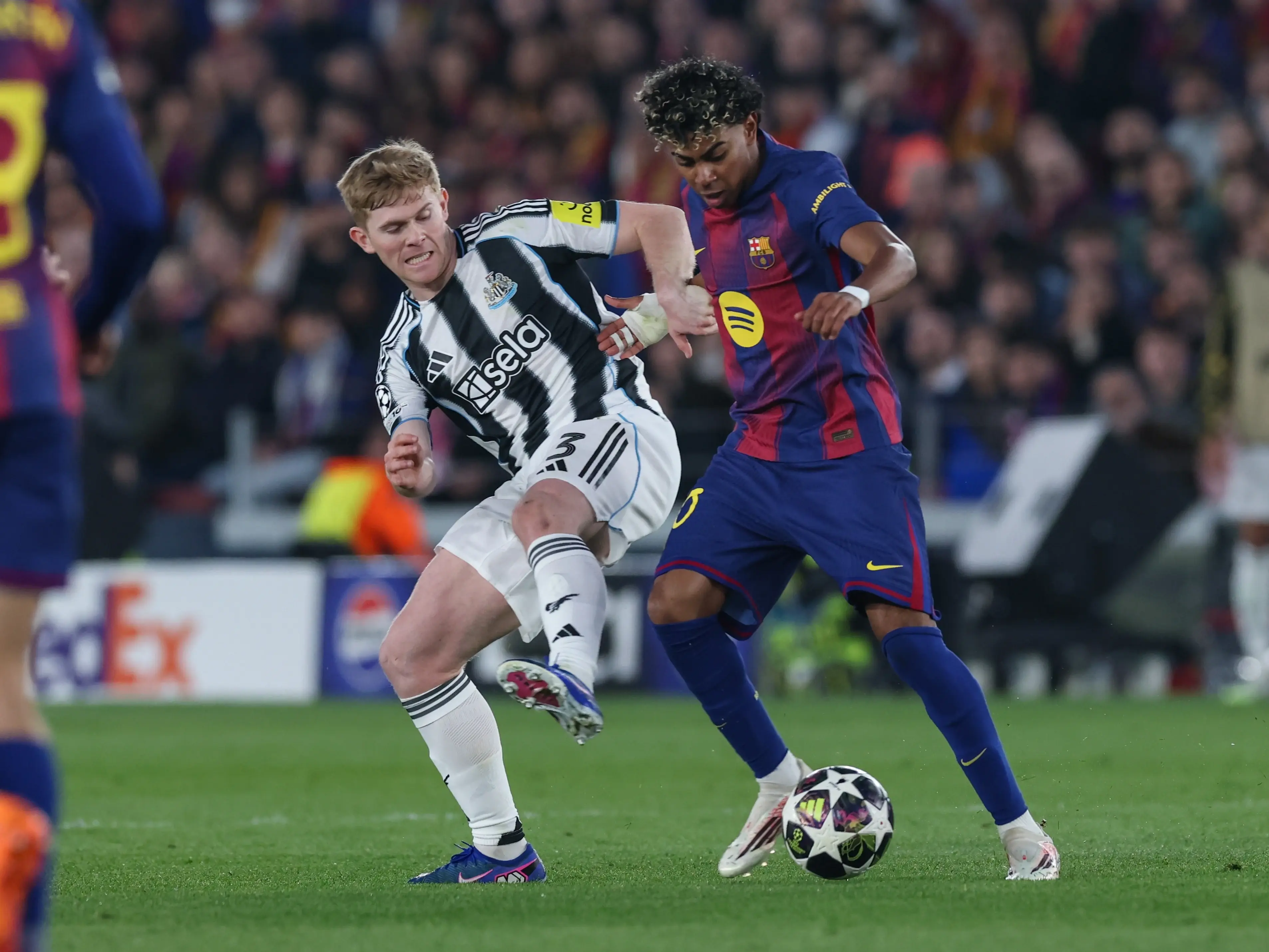
The discussion surrounding FC Barcelona following their recent victory over Newcastle United has been defined less by celebration and more by reflection. While the result secured the Catalan club’s place in the quarter-finals of European competition, the performance itself has prompted a range of measured reactions across the football community. Among those offering a thoughtful perspective was Lionel Messi, whose connection to Barcelona ensures that his words continue to resonate deeply, even years after his departure.

Messi’s assessment of the match was notably balanced rather than emotional. Speaking after observing the game, he suggested that Barcelona had benefited from moments that tilted in their favor, emphasizing that outcomes in football are often shaped by fine margins rather than dominance alone. His remarks were not framed as criticism for its own sake, but rather as an analytical reflection rooted in his understanding of elite competition. According to Messi, there were several key factors that contributed to Barcelona’s progression, each illustrating both the strengths and vulnerabilities of the current squad.
The first element he highlighted was efficiency in decisive moments. Barcelona, while not consistently controlling the tempo of the match, demonstrated an ability to capitalize on opportunities when they arose. In contrast, Newcastle showed phases of strong organization and attacking intent but lacked the clinical edge required at this level. Messi’s observation aligns with a broader truth in modern football: knockout matches are rarely about sustained dominance, but instead hinge on execution during brief windows of opportunity.

Another aspect Messi pointed to was the role of defensive resilience. Barcelona’s back line, anchored by players such as Ronald Araújo, endured periods of sustained pressure. Rather than collapsing under that pressure, they maintained their structure and composure. Messi acknowledged this as a positive trait, though he also noted that repeatedly inviting pressure is not a sustainable strategy against stronger opposition in later rounds. His remarks suggested a belief that while resilience is admirable, control remains essential for long-term success.
The third factor Messi mentioned involved the psychological dimension of the match. Barcelona’s experience in high-stakes European fixtures appeared to give them an advantage in managing key moments. Even when Newcastle pushed forward aggressively, Barcelona’s players showed composure in slowing the game down, drawing fouls, and disrupting the rhythm of their opponents. This ability to manage the emotional flow of a match is often overlooked but can be decisive in tightly contested encounters.
Despite identifying these positive elements, Messi’s overall tone indicated that he sees room for improvement. He noted that Barcelona’s midfield occasionally struggled to assert consistent control, leading to transitions that exposed defensive gaps. Additionally, he implied that the team’s attacking patterns lacked fluidity at times, relying more on individual moments than cohesive movement. These observations were not presented as definitive judgments, but rather as areas that could be refined as the competition progresses.
Shortly after Messi’s comments began circulating, a response emerged from within the Barcelona camp. Ronald Araújo, one of the team’s defensive leaders, offered a concise but meaningful reaction. Rather than engaging in a prolonged debate, Araújo emphasized the importance of results in football, suggesting that progression in a tournament is ultimately determined by performance under pressure. His response reflected a mindset focused on collective effort and forward momentum rather than retrospective evaluation.
Araújo’s perspective is indicative of a broader attitude within the squad. For current players, the emphasis lies in building consistency and confidence, particularly in a season where expectations remain high. While external analysis—including that of former players—can provide valuable insights, the internal focus is often centered on preparation and adaptation. Araújo’s brief statement underscored a belief that the team’s journey should be defined by its own evolution rather than external narratives.
The exchange between Messi and Araújo highlights an interesting dynamic between past and present at Barcelona. Messi represents an era of extraordinary success, during which the club set benchmarks for style and achievement. His standards, shaped by years of competing at the highest level, naturally influence his evaluation of current performances. At the same time, the present squad operates within a different context, facing new challenges and adapting to a changing football landscape.
For Barcelona, the victory over Newcastle serves as both an accomplishment and a learning opportunity. Advancing to the quarter-finals is a significant step, particularly in a competition where margins are increasingly narrow. However, the performance itself offers insights into areas that may require adjustment. Balancing defensive solidity with midfield control, improving attacking cohesion, and maintaining composure under pressure will all be crucial as the team prepares for more demanding fixtures.
Newcastle, for their part, can take encouragement from their performance despite the result. Their ability to challenge a club of Barcelona’s stature reflects progress and ambition. While they may have fallen short in key moments, the experience gained from such matches can contribute to their development on the European stage. The encounter demonstrated that the gap between teams is often less about quality and more about execution in decisive phases.
The broader reaction to the match also illustrates the evolving nature of football discourse. Rather than focusing solely on outcomes, there is an increasing emphasis on performance analysis, tactical nuance, and long-term development. Messi’s comments, as well as Araújo’s response, fit within this framework, offering different perspectives on the same event. Together, they contribute to a more comprehensive understanding of the game.
As Barcelona look ahead to the next round, the challenge will be to build on their strengths while addressing the concerns identified both internally and externally. The ability to adapt, refine strategies, and maintain consistency will determine how far they can progress. In knockout competitions, each match presents a new set of variables, requiring teams to remain flexible and focused.
Ultimately, the conversation sparked by Messi’s remarks and Araújo’s reply is less about disagreement and more about perspective. Messi’s analysis reflects the expectations associated with Barcelona’s historical identity, while Araújo’s response emphasizes the realities of contemporary competition. Both viewpoints offer valuable insights, illustrating the complexity of evaluating performance at the highest level.
In the end, Barcelona’s advancement speaks for itself. Results remain the definitive measure in football, even as the methods used to achieve them are scrutinized. The team’s ability to navigate a challenging match and secure progression is a testament to their resilience and determination. At the same time, the reflections that follow such matches serve as a reminder that success is an ongoing process, shaped by continuous learning and adaptation.
As the season progresses, Barcelona will aim to align performance with ambition, striving to meet the expectations that come with their history. Whether they can translate their potential into consistent excellence remains to be seen, but their journey will undoubtedly continue to attract attention and analysis from across the football world.